Most brands are remembered for a feeling, not a fact. Ask someone why they trust a brand and they rarely quote a tagline; they describe a moment — how a shop felt, how a product reveal landed, how an event stuck with them. That is the territory of experiential branding: building memory through what people see, do, and feel rather than what they read. And it is why physical spectacle, from pop-up installations to holographic displays, keeps pulling marketing budgets. The promise is real, but so is the trap. This guide is about using experiential moments to build durable brand memory — and knowing when a spectacle is doing brand work versus just entertaining a crowd.
The key takeaway up front: memorable is not the same as meaningful. A moment builds brand memory only when it is tied to something the brand actually stands for, repeated consistently, and given a reason to be recalled later. Spectacle without that scaffolding is a firework — bright, brief, and gone.
Why experience sticks better than a message
Human memory favors the vivid, the emotional, and the novel. A flat banner competes with thousands of other flat banners and loses; an experience that surprises the senses gets encoded more deeply because the brain flags it as worth keeping. Experiential branding leans on this directly — it trades reach for depth, reaching fewer people but leaving a stronger trace in each one.
That trade-off is the whole point. If you need to inform a million people that a sale ends Friday, an experience is the wrong tool. If you need a few thousand people to feel that your brand is modern, premium, or genuinely different — in a way they will still feel weeks later — a well-built experience outperforms almost any static format. The job of experiential branding is not volume. It is depth of memory.
Where holographic displays fit
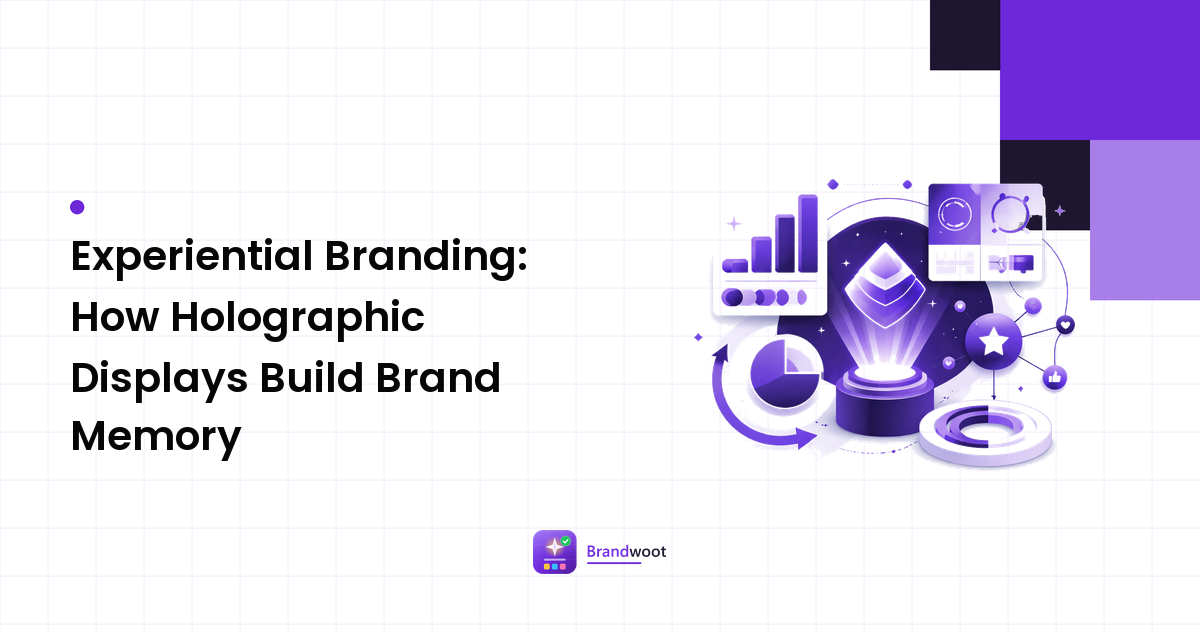
A "hologram fan" is not a true hologram. It is an array of LED-tipped blades spinning fast enough that your eye fuses the moving lights into a bright, floating image on a dark background. Larger setups tile several units into a wall. The effect reads as a 3D object hovering in mid-air with no visible screen — which triggers the exact "wait, how is that floating?" pause that experiential branding depends on.
For brand builders, that pause is the opening, not the payoff. The medium is strong at three specific jobs:
- Signalling a brand attribute instantly. The format itself reads as "modern, premium, tech-forward" before a single word is understood. If that is genuinely your positioning, the medium reinforces it; if it is not, it borrows a personality that will not match the rest of your brand.
- Making a single hero idea unforgettable. A product rotating, a logo assembling, a simple transformation — one clear idea rendered as a floating object is far more memorable than the same idea on a flat screen.
- Earning organic reach. People film novel experiences. The "did you see the floating shoe?" share is real earned reach that a static display rarely generates.
And it is weak — actively wasteful — in three others: carrying detail (pricing, copy, fine print die on a spinning LED field), running in bright or uncontrolled light (the image washes out), and serving as always-on wallpaper (novelty fades and audiences habituate). Match the medium to its strengths and it builds memory; fight them and you have bought an expensive gadget.
Turning a moment into brand memory
The difference between a spectacle people forget and one that builds equity comes down to four things.
- Tie it to one brand truth. Decide the single attribute the moment should reinforce — innovative, crafted, playful, premium. If a passer-by cannot infer that attribute from the experience alone, the memory will not attach to your brand.
- Make the brand the hero, not the tech. The most common failure is that people remember the floating effect and forget whose it was. The product, logo, or brand world must be the content, integrated into the surrounding space, not a gimmick parked beside your real message.
- Give the memory a hook to travel on. A short phrase, a distinctive visual, a name — something compact enough to survive being retold. Memory spreads through language; give people the words.
- Repeat the cue elsewhere. A moment seen once and never echoed decays. The colors, motion, sound, or shape of the experience should reappear in your packaging, social, and store so each later touchpoint re-fires the same memory.
A quick comparison: formats for experiential memory
Different experiential formats build memory in different ways. None is "best"; each fits a different goal, budget, and environment.
| Format | Memory strength | Best for | Main limitation |
|---|---|---|---|
| Holographic display / hologram fan | High novelty, strong "premium/modern" signal | Product reveals, windows, event booths in controlled light | Washes out in daylight; no detail; novelty fades if static |
| Interactive touchscreen or kiosk | Memory through participation | Product configuration, guided discovery | Needs dwell time and space; can feel utilitarian |
| Live demo or sampling | Memory through direct sensory proof | Food, beauty, tactile products | Labour-intensive; hard to scale |
| Projection / large-format screen | Memory through scale and storytelling | Atmosphere, narrative, daylight-tolerant settings | Less novel; competes with ambient light |
| Pop-up or set installation | Memory through immersion | Launches, flagship moments, PR | High cost per person reached |
Read across the table and the pattern holds: pick the format whose strength matches the attribute you want remembered and the environment you actually have.
Measuring brand memory (not just crowds)
A crowd filming your display feels like success, but attention is the input, not the outcome. Measure the thing you actually care about — memory and its effects:
- Recall and association. Simple before/after prompts with people exposed versus not: do they remember the brand, and do they attach the intended attribute to it?
- Earned reach. Organic shares, mentions, and user video tied to the activation — the memory spreading on its own.
- Downstream lift. Footfall, search for your brand name, or sales during and just after the activation, compared against a matched period or location.
- Next-step engagement. If you gave the moment a next step (a scan, a nearby product, a staff conversation), track how many took it.
Set the benchmark before you launch. An experience that lifts brand recall and branded search is doing its job even if it never earns a last-click sale — that was never its role.
FAQ
What is experiential branding, in plain terms?
It is building a brand through moments people experience — see, touch, feel, or do — rather than through messages they read. The goal is deeper memory and stronger emotional association, reaching fewer people but leaving a stronger trace in each.
Do holographic displays actually build brand memory or just draw a crowd?
Both are possible, and the difference is deliberate. A display draws a crowd by default; it builds memory only when it is tied to a clear brand attribute, makes the brand (not the effect) the hero, and is echoed across your other touchpoints so the memory keeps re-firing.
Are holographic displays worth it for a small brand?
They can be if your positioning is genuinely modern or premium, your space has controlled lighting, and your goal is a memorable moment rather than detailed communication. Renting for a launch or event is a sensible way to test the fit before any permanent commitment, and budget for purpose-built content, not repurposed video.
What should a hologram display actually show?
One hero idea on a true-black background — a product rotating, a logo forming, a single transformation — integrated with your brand world. Avoid text, pricing, or dense detail; the format carries one idea, not a spec sheet.
How do I know if an experiential activation worked?
Measure memory, not crowd size: brand recall and correct attribute association among those exposed, earned shares, and lift in branded search or footfall versus a comparable baseline. Decide those metrics before you launch.
The bottom line
Experiential branding works because people remember experiences long after they forget claims. Holographic displays are one of the more reliable ways to manufacture a memorable moment — but the moment only becomes brand memory when it carries a single clear truth about who you are, makes your brand the hero, and is echoed everywhere else you show up. Start from the memory you want people to keep, choose the format that fits that memory and your real environment, and measure recall rather than crowd size.
If that plan calls for a holographic display, treat the content and placement as seriously as the hardware, and source a supported unit from a specialist like Innaya rather than the cheapest unbranded fan that ships without help. Get the strategy right first, and the spectacle finally has something worth remembering.